OPEN SOURCE · Python · Apache-2.0 (schnell) / FLUX.1-dev Non-Commercial License (dev 系列) · Image

Flux
Open-weight text-to-image and editing models from Black Forest Labs with strong prompt adherence
Where it fits in the workflow
Flux is an image generation and editing model family open-sourced in August 2024 by Black Forest Labs (BFL), a Freiburg / Europe-based startup founded by several of the original Stable Diffusion authors (Robin Rombach, Andreas Blattmann, Björn Ommer, and others). Flux departs from the traditional UNet-diffusion design in favor of a Transformer architecture based on flow matching, delivering materially better prompt adherence and text rendering than contemporaneous SDXL-family models. The release ships three layers: the open-source inference repo on GitHub, the model weights on HuggingFace, and BFL's commercial cloud API at docs.bfl.ai.
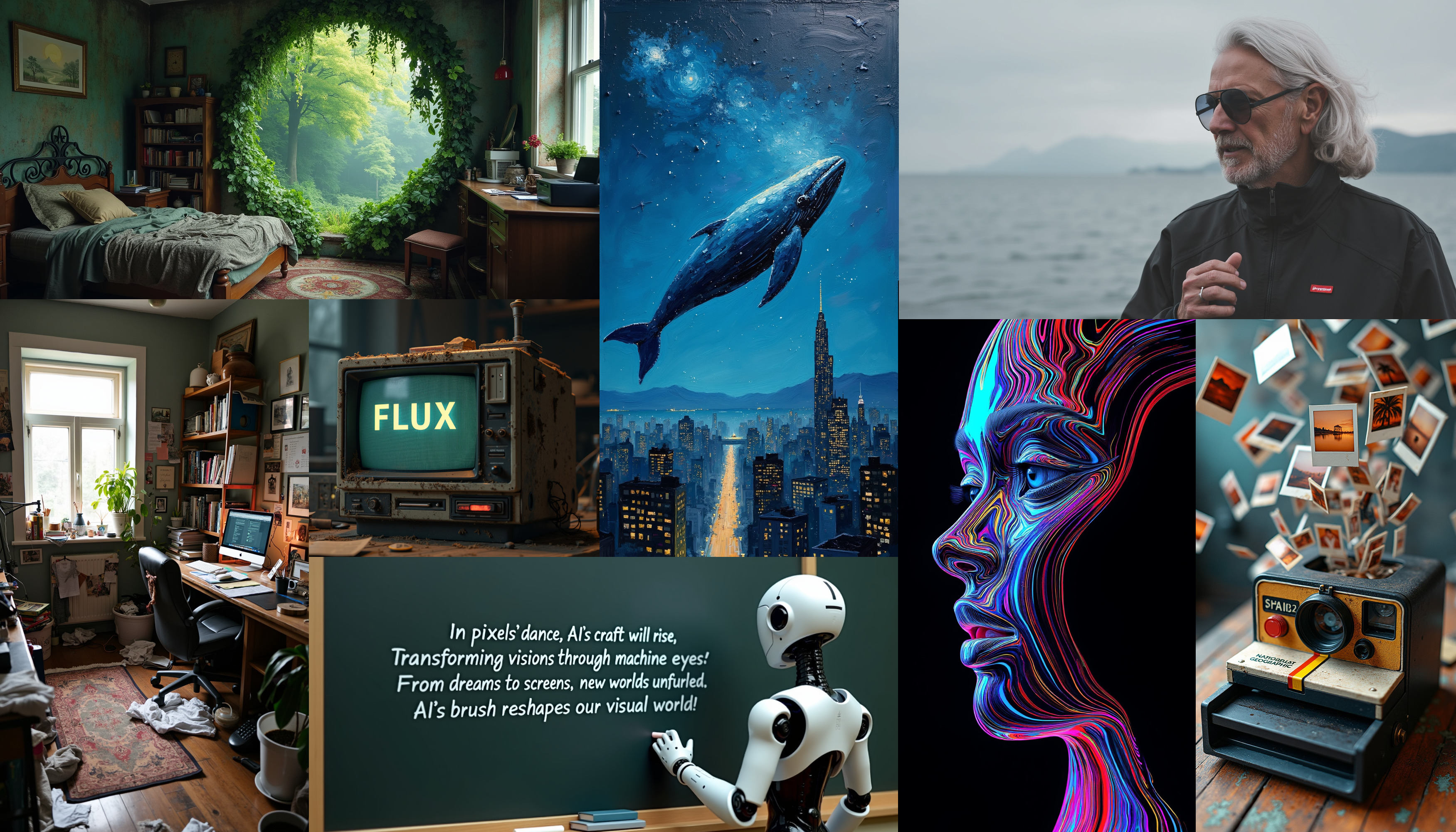
Core capabilities center on "open weights + a multi-size, multi-task model family". FLUX.1 [schnell] is the 4-step distilled fastest tier, released under Apache-2.0 with commercial use permitted; suitable for real-time previews and high-throughput generation. FLUX.1 [dev] is the 50-step guidance-distilled quality tier, released under the FLUX.1-dev Non-Commercial License (research / non-commercial only); stronger instruction following and quality than schnell. Editing and conditioning family: FLUX.1 Fill [dev] (in/out-painting for localized repaint and canvas extension), FLUX.1 Canny [dev] and FLUX.1 Depth [dev] (structural conditioning via Canny edges or depth maps, plus corresponding LoRA adapters), FLUX.1 Redux [dev] (image variation from a reference), FLUX.1 Kontext [dev] (image editing driven by natural-language instructions), and FLUX.1 Krea [dev] (a Krea-collaborated text-to-image variant). The autoencoder weights are released separately under Apache-2.0. Deployment shapes: standard install via git clone + Python 3.10 venv + pip install -e .[all]; an optional TensorRT path inside the NVIDIA NGC PyTorch 25.01 container (pip install -e .[tensorrt]); commercial usage tracking via the --track_usage flag integrated with BFL's API. Cloud API at docs.bfl.ai exposes higher-tier closed-source models such as FLUX Pro; commercial licensing happens through bfl.ai/pricing/licensing.
Use cases include: open-weight researchers running ablations and exploring new fine-tuning recipes (LoRA / ControlNet / IP-Adapter adapted to Flux), AIGC engineers embedding schnell into self-hosted products (Apache-2.0 commercial use), independent creators who need high prompt adherence and reliable text rendering (Flux materially outperforms SDXL on long prompts and brand-typography rendering), and B2B integrations reaching higher-tier models (FLUX Pro and beyond) through BFL's API. Hardware floor: standard install recommends an NVIDIA GPU with 8GB+ VRAM; CPU works but is very slow; the TensorRT path is best on post-Ampere NVIDIA GPUs. Language: the README is English-only and community docs are primarily English, but the model itself handles Chinese prompts reasonably well thanks to multilingual training data.
Licensing notes: FLUX.1 [schnell] and the autoencoder are Apache-2.0 and commercially usable; *FLUX.1 [dev] and the entire -dev family (Fill / Canny / Depth / Redux / Kontext / Krea) are under the FLUX.1-dev Non-Commercial License and cannot be used commercially without a separate agreement — for commercial use, route through BFL's API or purchase a license at bfl.ai/pricing/licensing. The repository has not received a new push since July 31, 2025 (the most recent commit corresponds to TensorRT path docs), but BFL continues to ship new models and versions on HuggingFace and via the API.
Screenshots







Workflow stage
Quick Start
Deployment guides and docs are linked externally to stay up to date.